In 2015, Earth saw the birth of a new island,
the first of its explosive type in 53 years.
The blast was so large that nearby tourists caught the explosion on camera.
Despite raging volcanic activity above and below the Earth's crust, an event like this is pretty rare.
Which is why it immediately caught the attention of Dr. Jim Garvin -
Chief Scientist at NASA's Goddard Space Flight Center and Mars expert.
It should be a pile of basaltic andesite rocks.
That's what you expect in this kind of setting
But there's more.
What answers does a Mars expert see in the island that the rest of don't?
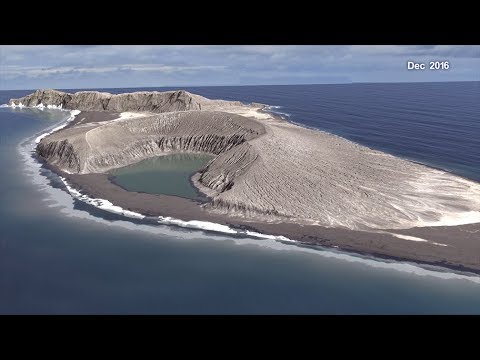
The new island unofficially known as Hunga Tonga-Hunga Ha'apai
is located in the remote Southwest Pacific,
nestled between two other islands in Kingdom of Tonga.
It's the first island of its kind to erupt and persist in the modern satellite era,
giving scientists an unprecedented view from space of its evolution.
There are other islands being formed including one's near Japan.
Very nice, lava eruptions, classic.
But this one was special because there was this explosive element that reminded us at first glance
– not exactly – of the kind of eruption at Surtsey.
This is the eruption Jim is talking about
– an island born from a similar explosive eruption in 1963 and one of only
three volcanic islands that have survived in the past 150 years.
Very early in Jim's career, Surtsey was the first newly-formed oceanic island he ever studied.
Years later, he went on to become NASA's Chief Scientist
pushing the agency's priorities towards Mars exploration that eventually led to the creation of
the Mars Exploration Rovers, the Mars Reconnaissance Orbiter
and the Mars Science Laboratory.
So why is a scientist clearly fixated on Mars intrigued by new land on Earth?
The truth is, the two systems are actually cosmically related.
I think these small islands, small volcanic islands,
freshly made, evolving rapidly, are windows into the role of surface waters on Mars
as they have effected small land forms like volcanoes.
And we see fields of them on Mars!
There's a lot to unpack there,
but before you can understand the major significance of this on Mars,
you have to understand why it's a big deal on Earth.
It really felt like we were witnessing something that nobody else had seen.
That's the voice Dr. Vicki Ferrini
– one of the first pairs of eyes to see the new island from the deck of her research vessel.
It's this crazy, huge land mass that's sticking up out of the water
where we know there wasn't one before.
We watched this island change.
And it got more and more exciting. It didn't wash away.
While there was massive erosion, there was redeposition protecting the island.
The initial mass above sea level was eroding very quickly
over the first three to six months and then it leveled off.
So you kind of see a curve –
a logarithmic fall off in change in that mass above sea level.
Basically, the island dramatically changed shape and size every day
for the first few months.
About six months in, it finally stabilized.
Vicki's initial measurements and observations were crucial,
but their research ship couldn't get close to the island without risking a collision.
Two French explorers who were sailing past the islands on their worldwide
voyage became NASA's eyes and ears, collecting some of the very first
images and samples of the interior island.
This is the Earth at its best.
Because new land, new life, new landscapes
and new patterns.
How do they all work together?
The combined observations, satellite images, samples
and three-dimensional topographical maps lead Jim and the team
to make some pretty stunning preliminary conclusions
Scientists think that, in this case,
warmed seawater interacted with ash after the eruption,
chemically altering the fragile rock into a tougher material.
But studying the life and death of land on Earth also has much broader implications.
This island may give us insights into if –
and how – life formed on Mars in its early history.
Islands like this might have worked on Mars.
Two or three billion years ago, lakes and small seas, filling depressions,
persistent surface waters – the stuff we really strive to understand
because it could have produced the conditions necessary for microbial life – or not!
While the verdict is still out on whether or not liquid water
on the surface of Mars may have produced life,
scientists are currently running detailed chemical analysis of the island rock samples
that will hopefully provide more answers in the months to come.
Earth is a magical place because, really,
it's our point of departure for everything.
And we come to realize in the last hundred years or so
that it's a far more dynamic world than we ever thought.
Which begs the question,
what new secrets will this planet we think we understand so well
reveal in the next 100 years?


 For more infomation >> Monday a.m. KSBW Weather Forecast 12.11.17 - Duration: 2:47.

 For more infomation >> Ei Meghla Dine Ekla (Cover) By Rajin ।। Bangla Video Song 4K (Ultra Hd)।। Youth Entertainment Box - Duration: 3:06.
 For more infomation >> Outlander Season 4 Teaser Promo (SUB ITA) - Duration: 0:21.
  For more infomation >> OUTRAGE After LIBERAL DOCTOR Busted Doing The UNTHINKABLE Inside Of A VA HOSPITAL… MADNESS! - Duration: 2:59.


Không có nhận xét nào:
Đăng nhận xét