(jazz guitar music)
- Using chromaticism has been a part
of the jazz tradition since bebop.
For many people a big part of the sound of a jazz solo,
especially a bop melody,
is the use of the chromatic passing notes.
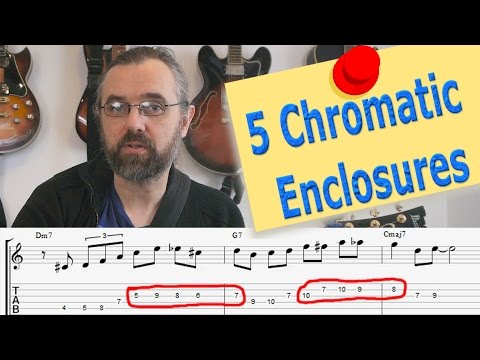
In this video I'm gonna go over five different
examples of chromatic enclosures.
I'm also gonna go over some examples
that are gonna show you how easy it is,
that if you know all your basic arpeggios,
you can use these chromatic enclosures to
get your lines to sound a lot more jazzy.
All the examples that I'm gonna go over in this video
are in the key of C,
so they're just a II V I in the key of C.
I'm gonna use the enclosures that I'm talking about
and demonstrating in the beginning of the lesson.
Then I'm going to use some fairly basic arpeggios
for each of the chords.
The first one is actually a personal favorite
that I use really a lot.
And that's this one.
Here I'm starting a half step below so really
with the chromatically note below it.
Then I'm skipping up
to a whole step above,
going down chromatically towards it,
then down under again and then I resolve on the three.
The second one sounds like this.
So the idea here is that
we start a whole step below
and then we move up towards the G
but then instead of going to the G
we go up a whole step above.
So up to the A
and then chromatically down.
The third example sounds like this.
Here I'm slow skipping around first
so we are starting fairly far away.
I'm starting a whole step above,
going a whole step under,
and then I'm moving up chromatically.
Then the other side chromatically also.
Then resolving.
The next one sounds like this.
This is almost reverse of what we just did.
I'm starting a whole step below.
Then skipping up to a whole step above.
Then I'm going down chromatically.
Then under,
and then resolving.
Then we have the last one.
Here I'm starting a whole step above.
Then moving down to a whole step below.
Then chromatically up to resolve.
The way you're gonna use this in a line
is that you're gonna take
a core tone that you decided in advance.
This is the note I want to target.
Then you put the enclosure in front of it.
This means that you have a way of either suspending`
the sound of the chord.
You're gonna be starting in the beginning of the bar
with the enclosure and then the sound of the chord
won't really appear until you're on beat three.
Or you're using it at the end of the bar
and then you're targeting a core tone in the next chord.
Both work really well because the idea with
the chromatic enclosure is that they're really
driving towards the note that they're resolving to.
In this first example,
I'm using the first enclosure that I went over.
I'm simply just starting with it.
We're essentially delaying the sound of the D minor
onto the third beat.
Because that's where we have the F
which is the note that we're targeting.
That's the enclosure
then it resolves to the F.
Then I'm skipping down from the F to the
fifth to A.
Then back up.
Then on the G7 I'm again using a chromatic enclosure.
It's not one that I actually talked about in this lesson
but it's also a very common one.
I'm starting on the fourth here.
Then I'm using three notes to get to the third.
I'm delaying the sound of the G7 until the two round.
Then I'm running down
what is essentially a G7 flat nine arpeggio.
Then resolving to the third of C.
Then over an E minor pentatonic scale.
In this line I'm starting off with a very simple
D minor pattern which is just a one, two, three, five.
So D, E, F, A.
Then I'm using the chromatic enclosure so the second one
to target the fifth of G7.
That means that in the D minor line
I'm already deciding I want to hit the D
on the one in the G7.
I'm doing that with
this enclosure.
Then from there I go to the D of course, resolve there.
Then a few chord notes,
up to the flat nine.
Then I'm just continuing up the diminished arpeggio.
Then resolving that on four and to the third of C,
which is E.
Then as a show of tack,
I'm just going chromatically down from D to B
which is from the nine to the seventh on the C major.
In this example,
I'm starting off with the enclosure
and we're again targeting the third of D minor
because that's a very nice clear note to target.
I'm starting a whole step above,
a whole step below.
Then chromatically up
and then the chromatically leading note above.
Then down to the third.
Then from here it's just a scale run.
Then I'm again using a chromatic enclosure to delay
the fifth of G.
I'm doing that with using the first one that I went over
in the first example.
Once I'm here I'm just running down the diminished arpeggio.
G7 flat nine will have a B diminished arpeggio
and that's this arpeggio inversion.
Then resolving that to the fifth of C
and then just adding these tacks to end on the nine.
In this example I'm using another idea
that's also very common for a more bop lines.
That is I'm using a leading note before an arpeggio.
I start on the one and
and then I want to play a D minor seven arpeggio,
but I start with a C sharp to lead into the D.
Then I'm playing the biggest part of the arpeggio
as an eight note triplet.
That means that
that's really sort of bringing out the seventh
here on the third beat.
From here I start the chromatic enclosure.
The idea here is of course just to
make an enclosure that's gonna target the fifth of G7.
Then that's the one I'm using
so whole step below,
whole step above,
half step above and then half step below,
and then resolving.
Then once I'm on G7
just a small scale run.
Then another enclosure.
This one I have actually laid out differently.
It's still just using first coming from below,
and then from above,
and then resolves to G, the fifth of C major.
And then this small tail through to get to the E.
Something I didn't mention before but of course
I've written out all the enclosures
as just played on one string,
but most of the time when you're using them
you can also experiment with using
several strings like I'm doing here.
It's maybe a little bit easier to get into your lines.
Also it sometimes will allow you to use some hammer-on
pull-off ideas that will make the phrasing better.
Maybe that's something I can return to in another lesson.
But I think it's quite important to also check out
not only the way I'm playing it in the first example
but also look for two string solutions
for playing these enclosures.
In this final example,
I'm again targeting the third of D minor seven.
I'm starting a whole step above,
going down chromatically.
Then a whole step below,
moving up and then resolving.
Then really to drive home this D minor sound
I'm just playing the triad.
That leads us really nicely into the D seven flat nine
with this arpeggio.
Then I'm using the D here as the first note
in a chromatic enclosure of the E on C major.
Then I'm tacking the phrase with
this short pentatonic fragment.
That was five examples of some chromatic enclosures
and also some examples of how I might use them in a line.
What you can probably tell from these examples
is that I'm really trying to keep the lines really clear
in the sense that I'm targeting the basic core tones,
the third and the fifth and sometimes the root.
The reason why I'm doing that is just to keep it clear
and because then you can probably easily hear
what is going on.
Of course you can also start to target nines and flat nines
and alterations and extensions but that's just for now.
It may be a little bit unclear to work with
so I thought it was better just to keep it
sort of lower in the chord.
If you want to download a pdf of the examples
that I went over in this video
then you can go to the article on my blog.
There's a pdf download of all the examples
of the lines and the enclosures.
While you're there you can of course also
subscribe to my newsletter.
If you do so you will receive an e-book
with 15 two, five, one licks with an altered dominant.
If you have any questions or comments or suggestions
for lessons then feel free to leave a comment on the video
or connect with me on social media.
I'm on Facebook, Twitter, Google plus, or Instagram.
This lesson is actually coming out
of a question that I got on a video about making
a lesson or a video on enclosures.
Please do feel free if you have an idea then
it's always nice to hear what you guys
want to hear videos on and maybe something
I can actually get into so then
we can get videos like this one.
If you want to keep me making all these videos
and you want to support me in that
then check out my patreon page.
I have a small patreon community right now
that is really helping me a lot in finding the time
and finding the money to keep on making all these videos.
I'm really grateful for that.
If you think that you might want to contribute something
you can do that already from one dollar
per weekly Youtube lesson.
Check out my patreon page.
That's the link in the description.
That's about it for this week.
Thank you for watching and until next week.


 For more infomation >> The Evolutionary Journey & Conscious Development of Happiness - Duration: 16:54.

 For more infomation >> El horóscopo de hoy, 13 de abril de 2017, por el astrólogo Mario Vannucci | Un Nuevo Día | Telemundo - Duration: 3:48.
  For more infomation >> Cómo enamorar a una chica por whatsapp, crear atracción y hacer que conteste tus mensajes - Duration: 12:51.
  For more infomation >> ¿Contratarías los servicios de un investigador privado? | Un Nuevo Día | Telemundo - Duration: 9:12.
 For more infomation >> ¡Animación, aventura y drama en los estrenos del cine! | Un Nuevo Día | Telemundo - Duration: 2:13.
  For more infomation >> América Pendurada em Uma Balança, Ofertas de Satanás Contra Nossas Orações - Duration: 13:30.
  For more infomation >> Las noticias de la mañana, jueves 13 de abril de 2017 | Noticiero | Noticias Telemundo - Duration: 4:45.
 For more infomation >> El gobierno de Trump ya tiene su "fuerza de deportación" | Un Nuevo Día | Telemundo - Duration: 0:31.


Không có nhận xét nào:
Đăng nhận xét