I don't know why but I always enjoyed listening to christmas Carols. Maybe it's due to their
connection with my favourite season or maybe they're just good songs, i don't know.
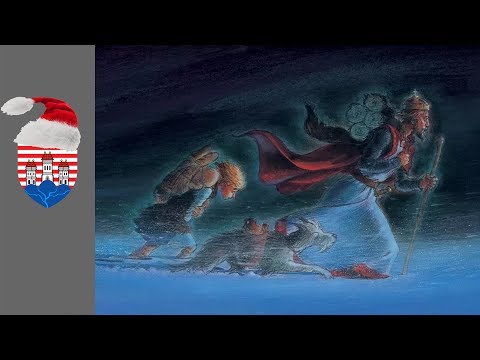
But with that said if I had to pick my favorite, I will probably have to go with "Good King
Wenceslas" , after all it's very well known even being sung by the soldiers in the
christmas truce. But to specify, when i said "Good King Wenceslas" I meant that I like
the translated czech version not the english one …
But wait hold on, translated in to Czech? Isn't Wenceslas a Czech king, … hhmm yehhh
he is, well not this one, or this, or this one, not any of them, in fact the king we
call the Good King Wenceslas or also known as St. Wenceslas the patron saint of Czech
Lands lived in the 10th century and was the first king of Bohemia ever to be called Wenceslas,
So all these other guys are just posers.
But digress, now that we know which Wenceslau of bohemia the song is talking about, why
isn't the original carol in Czech? Well for that we will have to do some extensive
digging as the answer isn't as simple as you may think. So to start off we will have
to skip St Wenceslaus actual life in the 10th century as the origin of the carol surprisingly
doesn't start with him. It was in fact during the high middle ages around the early 13th
century when the melody and the trochaic meter of the song was created, but it wasn't a
christmas carol. It was a latin spring song called "Tempus adest floridum" which talked
about blooming flowers and the coming of warmth right after the frost of winter. This song
wasn't written down for much of its early existence so no one really knows where it
came from. But this is how it sounded like …
So pretty much very similar to the Wenceslau Carol today just with different words.
Continuing on from there Tempus adest Floridum was finally written down in Finland around
the 16th century in to a book called Piae Cantiones. This book which was a collection
of multiple medieval songs eventually found its way to England where in the 19th century
it came in to the hands of John Mason Neale.
He was known in England as a devout christian, hymn writer and specially a hymn translator
of old latin medieval texts. And this is where Tempus adest floridum comes in to play, as
he is the one who took the melody of that song and used it for a christmas song he wrote
called "Good King Wenceslas". He then published this song in 1853 which was meat
with mixed results, however over time it became one of the most well known christmas carols
not just in the English speaking world but also in the rest of Europe.
So when does Czech come in to play to any of this? Well if you look closely on the wikipedia
article for the Good King Wenceslas carol, there's a sentence mentioning that, According
to older Czech sources, Neale's lyrics are a translation of a poem by Czech poet Václav
Alois Svoboda, written in Czech, German and Latin. Why those three languages you ask,
well because Bohemia was part of the Austro-Hungarian empire, and if you wrote something in czech
you also had to write it at least in German and Latin so other people in the Empire could
read it. But I digress, again. Continuing from there in true wikipedia fashion when
you click the source for this sentence the page doesn't exist.
Does this mean that the Czechs just made this up so they could lay some sort of a hypothetical
claim to a popular english christmas carol about their old king. Well that's what I
thought after googling for the original poem written by Vaclav and only coming across numerous
pages like this one on duolingo where even people from Czech republic where unable to
find the original poem. With my luck being no different, I was almost about to decide
that the poem was just made up Czech Propaganda and leave it at that.
But then I came across this book written in Czech in 1902 where on the page 208 the writer
complains about Vaclav not getting any credit for writing the original "Good King Wenceslas"
poem in 1847 which would be 6 years before Neals publication of his carol. The writer
goes on to sight his source where he names the poem in german Sanct Wenzel und Podiwini.
Which means Saint Wenceslas and Podiwin ? Whatever that is.
But now I have a source, so I can just plug this in to google and find the original. Well
turns out no. Because even mighty google has no idea what this source means. Even if you
just put in the supposed german name of the poem, nothing turns out. So now I am back
to square one as the Austrian, Czech, German and Oxford online library archives along with
google turn out nothing when you type in the supposed name of the poem outside of that
one book that is referencing it.
But at this point I am not willing to give up just yet. I decided to change my approach
from searching just for the poem to searching for the author of the poem. Although at that
moment I realized I completely forgot to address the problem every Austro-Hungarian scholar
faces and that is multiple names and variations of names for one thing. So when it came to
the author of our supposed poem, turns out he had 15+ different variations of his name.
These variations weren't large but when dealing with library databases a single letter
change can make a big difference. Plus, the authors first name Vaclav is the Czech name
from which the english Wenceslas is derived from. So I am searching for a poem with king
named Wenceslas and the writer named Wenceslas. Or Wenceslas and Vaclav, or Vaclac and Vaclav?
Nein, er heißt Wenzel. Nie ma na imię Wacław. Nem a neve Wenceshlaus. (slures) Pred oknom,
za oknom, stoji mikulas, povedz nam dedusko … ha co tu vsetci robyte ? Aghhhhh, lets
go back to the drawing board.
Now we know there's multiple variations for not just the name of the author but also
the poem. So we could have just been searching with a bad variation of the poem's name. I
quickly write out some plausible name variations and go back to the aforementioned online databases.
I still have no luck finding the exact poem but I do find numerous amounts of writings
mentioning or referencing the 1847 Wenceslas poem. I also find that Podivin isn't a weird
german word but an actual name of the king's favorite servant in the 10th century. I even
manage to find the book keepings of either a Prague based publisher or just a bookseller
(I can't tell) selling the Sanct Wenzeslaw und Podiwin poem for 10 Austro-Hungarian crowns
in 1847. Now finally convinced the actual poem exists, I am poised to finally find it.
So at this point it's time to turn to my last plan which is searching for all the different
variations of the authors name and then looking if one of the works that come up is the Good
King Wenceslas poem. I go to the Austrian National library first, and nothing. I then
go to the Czech national library and after a few tries of different name variations I
finally find the Czech and German version of the poem. But, i can't see them, because
they're not digitised. I can however schedule a meeting and fly to Prague to see the works
with my own eyes … apparently.
This is so weird. You complain for a Czech not getting credit for creating the original
Good King Wenceslas poem but then hide the actual original poems from anyone reading
it. You don't have to take pictures of the originals if it will ruin them, at least write
them down on a blog post or something so we can at least see what the original poem says
… Unless, it doesn't actually exist. Yes there are many references citing the poem,
but we never seen the original. Maybe this is just a weird cycle where everybody is references
something that doesn't actually exist. And it got to such a point that the Czech National
library mentions the poems under the writers creations without really looking if they actually
have them. Brushing it off as in ou it's in just an old pile of books somewhere maybe.
But they don't actually have it. That would be crazy, that would never happen, right?
Well, actually, in this case it didn't happen. How do I know. Because even though I haven't
seen the original poem a week later I managed to find an 1847 Austrian Yearbook for teachers,
parents and educators which along with math problems and other things that teachers would
like has the German version of Vaclav Alois Svoboda's Sanct Wenceſlaw und Podiwin poem,
published that same year.
Now finally that we have the poem we can look if Neal actually just translated Vaclav's
poem or created his own song. Disclaimer keep in mind my German isn't great but I'll
try my best.
What we can say for sure just from the first look is that Neal didn't just straight up
translate the poem into english and that was that, this is because Neal's carol has only
5 stanzas where as Vaclav's poem has 3 verses together numbering in 26 stanzas. Plus Neal's
carol has an alternate rhyming scheme (ABABCDCD...) as opposed to Vaclav's poem which has 2
different rhyming schemes starting with a couplet (AABBCC…) which then switches in
to an alternate. This means without alterations Vaclav's poem couldn't even be sung to
the good King Wenceslas tune.
However when you start looking at the context of the poem, that's where things get interesting.
Both works start of with a clear moonlit night with snow on the ground. Both have the King
Looking out of his Window, Both have the King Spotting some poor person/people struggling
in the winter night, both have the king deciding he needs to help the said poor person/people,
both a servant helping the king carry wine, food and wood, to the poor person/people both
have the servant struggling to move any longer in the cold and both have the king telling
the servant to walk in his footsteps as it will be easier for him.
In conclusion it seems too coincidental for there to be so many similarities between these
two works. Therefore it's safe to say that Neal definitely took the story of Good King
Wenceslas from Vaclav's poem. After that, he shortened it, altered it to fit the tune
and published it, without crediting or even mentioning Vaclav at all.
So next time when you hear the Good King Wenceslas carol you'll know it's a story about a
10th century Bohemian king from a 19th century czech poet altered by an English hymn writer
to fit a 13th century spring tune.
I have promised for a while now that I'll do a QnA when I reach 10k subscribers and
since it looks like I should reach that milestone in January I have decided that my January
video is going to be a QnA. So if you want to ask me a Question there's a link to a
google form in the description, please don't leave your questions in the comment section
or on Twitter, I will only answer the Questions from the google form. I hope you enjoyed my
Christmas special video, please consider supporting me on Patreon and I also have a YouTube History
podcast with Cogito you can listen to. Merry Christmas.

 For more infomation >> 2019 Honda CBR250RR Repsol Red White Limited Edition - First Look | Mich Motorcycle - Duration: 2:06.


 For more infomation >> Museo Thyssen Bornemisza di Madrid - Duration: 5:00.
 For more infomation >> 菲儿 - 我要找到你 - Duration: 3:35.
  For more infomation >> Eskil tester robot-programmering 🤖 - Duration: 1:27.
 For more infomation >> WWE 2K19 - Duration: 0:48.

Không có nhận xét nào:
Đăng nhận xét