We're now entering the final days for NASA's Kepler Space Telescope.
It's running out of fuel and already crippled by the loss of its reaction wheels.
In just a few months NASA will shut it down for good.
That is sad, but don't worry, NASA's next planet hunting spacecraft, the Transiting
Exoplanet Survey Telescope is on the launchpad and ready to fly to space to take over where
Kepler left off.
Finding Earth-sized worlds in the Milky Way.
It's hard to believe that we've only known about planets orbiting other stars for just
over 20 years now.
The first extrasolar planet found was the hot jupiter 51 Pegasi B, which was discovered
in 1995 by a team of Swiss astronomers.
They found this world using the radial velocity method, where the gravity of the planet pulls
its star back and forth, changing the wavelength of the light we see ever so slightly.
This technique has been refined and used discover many more planets orbiting many more stars.
But another technique has been even more successful: the transit technique.
This is where the light from the star is carefully measured over time, watching for any dip in
brightness as a planet passes in front.
At the time that I'm recording this video in April, 2018, there are 3,708 confirmed
planets with several thousand more candidates that need additional confirmation.
Planets are everywhere, in all shapes and sizes.
From the familiar gas giants, rocky worlds and ice giants we have in the Solar System,
to the unusual hot jupiters and super earths.
Astronomers have even found comets in other solar systems, planets like Saturn but with
ring systems that dwarf our neighbouring planet.
The hunt is even on for exomoons.
Moons orbiting planets orbiting other stars.
NASA's Kepler Space Telescope was the most productive planet hunting instrument ever
built.
Of those 3,708 planets discovered so far, Kepler turned up 2,342 worlds.
Kepler was launched back in March 2009, and began operations on May 12, 2009.
It used its 1.4 meter primary mirror to observe a 12-degree region of the sky.
Just for comparison, the Moon takes up about half a degree.
So a region containing hundreds of times the size of the Moon.
Kepler was placed into an Earth-trailing orbit around the Sun, with a period of 372.5 days.
With a longer year, the telescope slowly drifts behind the Earth by about 25 million km per
year.
As I mentioned earlier, Kepler was designed to use the transit technique, searching for
planets passing in front of their stars in this very specific region of the sky.
While previous exoplanet surveys had only found the more massive planets, Kepler was
sensitive enough to see worlds with half the mass of Earth orbiting other stars.
And everything was going great until July 14, 2012 when one of the spacecraft's four
reaction wheels failed.
These are gyroscopes that allow the spacecraft to change its orientation without propellant.
No problem, Kepler was designed to only need three.
Then a second wheel failed on May 11, 2013, bringing an end to its main mission.
What the Kepler engineers came up with is one of the most ingenious spacecraft rescues
in the history of spaceflight.
They realized that they could use light pressure from the Sun to perfectly stabilize the telescope
and keep it pointed at a region of the sky.
This allowed Kepler to keep working, observing even larger portions of the sky, but its orbit
around the Sun would only let it watch one region for a shorter period of time.
Instead of scanning Sun-like stars, Kepler focused its attention on red dwarf stars,
which can have Earth sized worlds orbiting them every few days.
This was known as the K2 era, and during this time it turned up an additional 307 confirmed,
and 480 unconfirmed planets.
But Kepler is running out of time now.
About a month ago NASA announced that Kepler's almost out of fuel.
This fuel is important because one important maneuver it needs to make is to point itself
back and Earth and upload all the data it's been gathering.
NASA figures that's just a few months away now, and when it happens, they'll instruct
the telescope to point at Earth for one last time, transmit its final data, and then shut
down forever.
I know this is super sad, and you should definitely shed a tear for Kepler when it does go silent.
But you won't have to wait long for an exciting new spacecraft to take its place: The Transiting
Exoplanet Survey Telescope.
And I'll tell you all about it in a moment, but first I'd like to thank:
George Barr POV_Dave
Orlando Gonzalez Neil Upfalow
Dirk Hoenes Christian Fattarsi
Andrew Poelstra George Lancaster
And the rest of our 808 patrons for their generous support.
If you love what we're doing and want to get in on the action, head over to patreon.com/universetoday.
If all goes well, a SpaceX Falcon 9 rocket will blast off from Cape Canaveral any day
now.
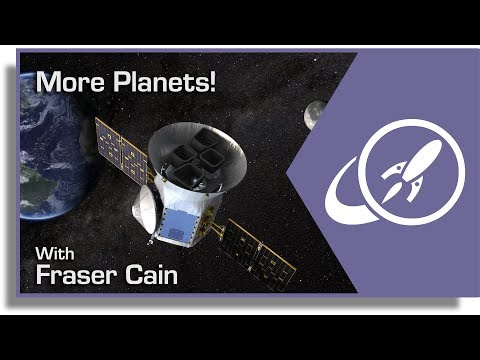
It's carrying NASA's Transiting Exoplanet Survey Telescope, or TESS, the sequel to Kepler,
taking the search for exoplanets to the next level.
The TESS mission has been around in some form since 2006 when it was originally conceived
as a privately funded mission by Google, the Kavli Foundation and MIT.
Over the years, it was proposed to NASA, and in 2013, it was accepted as one of NASA's
Explorer Missions.
These are missions with a budget of $200 million or less.
WISE and WMAP are other examples of Explorer Missions.
But there are a bunch of differences between Kepler and TESS.
Remember when I said that Kepler was observing a 12 x 12 - degree region of the sky?
TESS will be surveying the entire sky, an area 400 times larger than what Kepler observed.
It has a set of 4 separate identical telescopes with CCD cameras, each of which are 16.8 megapixels.
They're arrayed to give TESS a 24-degree square view of the sky.
TESS will break up the sky into 26 different sectors and study the region for at least
27 days, switching from bright star to bright star every two minutes.
While Kepler was doing a deep dive into one specific region of the sky, TESS is going
to be observing the 500,000 brightest stars in the sky, which are 30 to 100 times brighter
than the kinds of stars Kepler was looking at.
Many of which will be stars like our own Sun.
It'll be capable of surveying the entire sky over the course of two years, which is
an area 400 times larger than Kepler observed.
And astronomers are expecting that the mission will turn up thousands of extrasolar planets,
500 of which will be Earth-sized or super-Earth-sized.
By performing this wide survey of the sky with bright stars, TESS will be finding the
close extrasolar planets.
If a bright star has planets passing in front of it from our perspective, TESS will find
it.
It will create the definitive catalog of nearby planets.
Since these worlds are much brighter in the sky, it'll be easier for the world's ground
and space-based observatories to do follow up observations.
Astronomers will be able to measure the size, mass, density and even the atmospheres of
extrasolar worlds.
Just wait until James Webb gets its detectors on some of these worlds.
In addition to its primary job of finding planets, NASA has invited Guest Investigators
to use the spacecraft for other science research, such as finding quasars, tracking stellar
rotation, and observing the variations of dwarf stars.
Anything that has a change in brightness will a great target for TESS.
One interesting feature of the TESS mission will be its orbit, taking it on a path that
no other mission has ever used.
It's called a "P/2 lunar-resonant" orbit, and takes the spacecraft on an elliptical
trajectory that takes half as long as the Moon to orbits the Earth - 13.7 days.
At its closest point to Earth, it'll be 35,785 km above the surface and take three
hours to transmit all its data to ground stations.
Then it'll fly out to the highest point, at an altitude of 373,300 km, out of the hazards
of the Van Allen Belts.
By the time the TESS mission wraps up, we're going to know a lot about the extrasolar planets
in our nearby neighborhood.
Well, a lot about the planets that perfectly line up with their stars from our perspective.
And sadly, this is only a couple of percent of the star systems out there.
We're going to need other techniques to find the rest, which I'm sure we'll be
covering in future episodes.
Are you sad about Kepler, excited for TESS?
Let me know your thoughts in the comments.
Once a week I gather up all my space news into a single email newsletter and send it
out.
It's got pictures, brief highlights about the story, and links so you can find out more.
Go to universetoday.com/newsletter to sign up.
And finally, here's a playlist.
 For more infomation >> Ne-Yo Announces Billboard Music Award Nominees Live | TODAY - Duration: 3:20.
  For more infomation >> Video: Sun returns Wednesday - Duration: 3:24.
  For more infomation >> Christian Nodal le envía mensaje a Maluma | Suelta La Sopa | Entretenimiento - Duration: 1:27.
  For more infomation >> The Weeknd y Bella Hadid retoman su relación | Suelta La Sopa | Entretenimiento - Duration: 0:33.
  For more infomation >> Noticias Telemundo Mediodía, 17 de abril de 2018 | Noticiero | Telemundo - Duration: 21:37.
  For more infomation >> 12 signs that may indicate heart problems | Natural Health - Duration: 3:34.
 For more infomation >> Demandan a Mariah Carey por acoso sexual | Suelta La Sopa | Entretenimiento - Duration: 0:33.
  For more infomation >> El elenco de "Luis Miguel La Serie" hablan de sus personajes | Suelta La Sopa | Entretenimiento - Duration: 1:58.
 For more infomation >> Kendrick Lamar recibe el Premio Pulitzer de Música | Suelta La Sopa | Entretenimiento - Duration: 0:34.
  For more infomation >> El apoyo más grande de Esteban Loaiza: Cristina Eustace | Suelta La Sopa | Entretenimiento - Duration: 3:31.
 For more infomation >> Miguel Leone es acusado de encabezar red de prostitución | Suelta La Sopa | Entretenimiento - Duration: 3:00.
  For more infomation >> Portion of Colonial Drive remains close amid bridge inspection - Duration: 2:42.

Không có nhận xét nào:
Đăng nhận xét