this video is sponsored by Audible.
hey, welcome to 12tone! if you've ever listened to music from Latin America, you've probably
noticed that it tends to be very rhythmically dense.
there's lots of instruments playing lots of different parts, with everything woven together
into an incredibly rich tapestry of sound, but at the heart of it all you'll often find
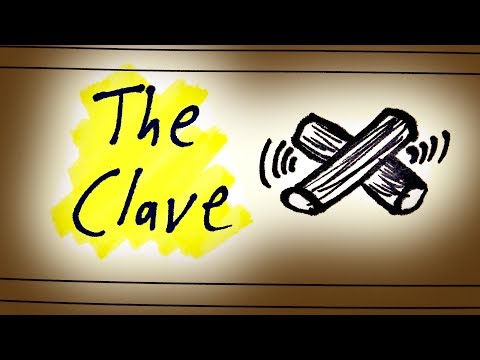
two humble wooden sticks playing one of the most important rhythms in the history of music,
and it sounds something like this: (bang)
that's called a clave, or more specifically a son clave: there's a couple different kinds
of claves associated with different styles of Latin music, and we'll get to those in
a bit, but first I want to make sure you understand just how important they are.
claves are very old: they likely originated in Africa and were brought to the Americas
via the transatlantic slave trade.
as far as I could find, we don't know for sure exactly how far back they go, or how
they evolved over those years: as you might imagine, academics of the time didn't devote
much of their attention to studying the rhythmic structures of slave music.
but given the clave's similarity to more modern African rhythms, it seems very likely they
at least share a common ancestor.
while claves are traditionally associated most strongly with Afro-Cuban music, the rhythm
can be found across all sorts of different styles, even outside of Latin America.
it shows up regularly in jazz, for instance, and it's also common in rock, where it's sometimes
known as the Bo Diddley beat, after its use in the song Bo Diddley by the artist Bo Diddley.
really, if you listen to any sort of modern music there's a good chance you've heard some
version of it somewhere.
so how does it work?
well, basically, the clave is kind of like a wobbly metronome.
like, in standard meter we have regular quarter notes (bang) where each beat lasts the same
amount of time.
it's completely symmetrical: any one of these could be the downbeat and nothing would change.
but with a clave (bang) each beat is different, and if you change which note is the downbeat
(bang) you change the entire sound.
Afro-Cuban music takes this uneven metronome thing very seriously: not all parts play the
clave, just like how you might not play every quarter note, but every part is built around
the clave, filling gaps in between and emphasizing the rhythmic structure of the pattern.
it's the foundation on top of which the rest of the rhythm is built.
heck, clave is literally spanish for "key", and scholars have compared it to the keystone
of an arch, holding the rest of the music together.
so yeah, it's a pretty big deal.
but let's move on to the rhythms themselves.
probably the most common version these days is the son clave, (bang) named for its use
in the Son Cubano style of music.
this, like the other claves we'll look at, is a two-bar pattern with three beats in the
first bar and two in the second.
notice that that second bar has nothing on the downbeat: the clave rhythm actually stretches
across the barline, obscuring the beginning of the second bar. this helps emphasize that
it's one complete rhythmic pattern that just happens to take two bars to complete.
structurally, it starts out with these three evenly-spaced notes, implying normal quarter
notes at a faster tempo (bang) but instead of continuing that pulse, it pauses for a
second here, then turns around and plays these two fast notes before resetting.
it creates a sort of lopsided feel where the tempo seems to keep speeding up and slowing
down, and the rhythm lurches back and forth instead of proceeding smoothly.
shifting attacks onto unexpected parts of the bar is called syncopation, and it makes
it much more interesting to dance to, providing a more complex structure with different patterns
of emphasis to move along with.
the other common claves patterns are the rumba clave and the bossa nova clave, both of which
are effectively more complex versions of the son clave.
well, that may not be historically accurate: the rumba clave, at least, probably predates
the son clave, although again the history is not well-recorded.
but structurally, at least, it looks like a variation, so for our purposes that's close
enough.
if we look at the son clave (bang) we see that of the five hits, four of them take place
on 8th notes.
there's this one lonely little 16th, but that's it.
the other two claves each shift one of those 8ths back a bit, creating a bit more syncopation
to add some extra spice.
the rumba clave moves this third note, (bang) which kinda moves it into the second half
of the rhythm even though it stays in the first bar, while the bossa nova clave moves
the fifth note instead (bang) mellowing out that rushed ending and creating a pattern
that mathematicians call "maximally even", where the notes are as evenly spaced as possible
across the bars. we can also combine these two alterations to make we might call a bossa
rumba clave (bang) although, full disclosure, I found no evidence that anyone's actually
used that rhythm.
still, it sounds nice.
so those are the three main claves, but there's still plenty of different ways to use them.
for instance, you may have noticed that in each of the examples, we had a bar with three
notes and then a bar with two.
(bang) but what if we flipped them and put the two-note bar first?
(bang) this gives us what's called a 2:3 clave, as opposed to the 3:2 ones we were looking
at earlier.
note that, traditionally, you wouldn't flip back and forth between them in a single song
like I just did: once the clave is set, you tend to stick with it.
again, it's basically a metronome, so changing it mid-song can be confusing.
of course, we can also make 2:3 versions of the rumba clave (bang) and the bossa nova
clave (bang) where you can really feel that maximally even spacing.
another thing we can do here is to drop the 2-note bar entirely and just loop the 3 part,
like this: (bang) this gives us a rhythm called a tresillo, which is spanish for "triplet"
because it's the three-note section of the bar. this can cause some confusion because
tresillo is also used in Spanish to describe the rhythmic figure that English speakers
called triplets, where one beat is broken up into three even parts instead of two (bang)
but in the context of Cuban music, "tresillo" usually refers to this slightly uneven version
instead.
to make things even more confusing, though, actual triplets are also involved in clave
theory.
or at least triple meter is, which is a rhythmic feel where every single beat is divided into
triplets, and we can fairly easily transpose our claves into that feel.
if we take the son clave (bang) and drop the second 16th note from each beat, we get this
(bang) which has basically the same structure but in triple meter. we can do the same thing
to the rumba clave (bang) but you don't tend to see this with the bossa nova clave: it
uses all the different 16ths so the conversion doesn't quite work.
it's also much newer than the other claves, and as far as I could tell these triple meter
versions actually came first, so it makes sense from a historical perspective that the
bossa nova wouldn't have one.
so, yeah.
claves are one of the most important rhythms in music, and they show up all over the world.
in Cuban music they hold a special significance, serving as the foundation on top of which
the rest of the piece is built, but the rhythms also see plenty of use in other cultures as
well.
I'd say experiment with them, but given how prevalent they are, there's a good chance
that even if you didn't know it, you probably already have.
speaking of trying new things, let's talk about Audible.
a couple weeks ago I made a video about how learning poetry could make you a better lyricist,
and I got a lot of people asking for recommendations on how to find good poems.
Audible has the largest selection of audiobooks on the planet, including plenty of fantastic
poets, and the great thing about listening to audiobooks of poetry is that you can really
hear how things like meter and rhyme schemes interact.
a personal favorite is A.E.
Housman's collection A Shropshire Lad: Audible actually has three different readings of it,
but I'd recommend the David Moore version.
plus they also have the complete collection of Shakespeare's sonnets if that's more your
thing.
or you could get any other book you want: if you go to Audible.com/12tone or text 12tone
to 500500 you can sign up for a free 30-day trial membership, and a membership gets you
a free book every month which is yours to keep even if you cancel later, so basically
it's just a free audiobook, no questions asked.
plus as long as you're a member you can exchange your audiobooks for free too.
so yeah, just visit Audible.com/12tone, or text 12tone to 500500 to get started.
again, that's Audible.com/12tone, or text 12tone to 500500.
thanks!
and hey, thanks for watching, thanks to our Patreon patrons for making these videos possible,
and extra special thanks to this video's Featured Patron, Duck. if you want to help out, and
get some sweet perks like sneak peeks of upcoming episodes, there's a link to our Patreon on
screen now.
you can also join our mailing list to find out about new episodes, like, share, comment,
subscribe, and above all, keep on rockin'.


 For more infomation >> Haley Joy Is Obsessed With Hoda's Phone! | TODAY - Duration: 3:33.
 For more infomation >> Shannon Purser Spotlight - Last Call with Carson Daly (Interview) - Duration: 5:03.
 For more infomation >> Dems Plan Has BACKFIRED! Trump is Now Poised to Win DOUBLE the Amount for His Border Wall - Duration: 3:16.
  For more infomation >> Michel Gondry Spotlight - Last Call with Carson Daly (Interview) - Duration: 5:08.
  For more infomation >> Obama's Right-Hand Man Betrays Him, Reveals Barack's Hidden Syria Skeletons - Duration: 2:41.
  For more infomation >> The Purge 1x03 Promo "The Urge to Purge" (SUB ITA) - Duration: 0:21.
  For more infomation >> Judy Greer On Stepping Behind The Camera For Latest Film | TODAY - Duration: 3:13.
 For more infomation >> McCaskill UNDER FIRE as More Deception is Uncovered in Her Husband's Federal Subsidies Scandal - Duration: 3:20.

Không có nhận xét nào:
Đăng nhận xét